
When planning a safe and dependable electrical system, the size of the protective piping matters more than many people realise. Choosing the right conduit pipes helps organise wiring, reduces the risk of cable damage, and supports easier maintenance in the future. Whether you are constructing a new home or renovating an existing property, understanding conduit sizes can prevent unnecessary complications later. From carrying a few lighting cables to accommodating larger power circuits, every application requires careful consideration to achieve long-lasting electrical safety and performance.
What Is a PVC Conduit Pipe?
A PVC conduit pipe is a rigid or semi-rigid tube used to house and protect electrical wiring as it runs through walls, ceilings, and floors. Rather than leaving cables exposed to moisture, heat, or physical knocks, the conduit gives them a sealed, organised pathway from the distribution board to every switch and socket in the building.
PVC Conduit Pipe vs PVCPlumbing Pipe
It is worth being clear on this distinction, since the two are sometimes mixed up. Plumbing PVC pipe is built to carry water under pressure and is tested for that purpose. Conduit pipe is built to protect wiring and is tested for impact strength, flame resistance, and electrical insulation instead. The two are not interchangeable, and using plumbing pipe for wiring, or vice versa, defeats the safety standards each one is designed around.
Why Does PVC Conduit Pipe Size Matter?
Size is not a small detail. It affects how the entire wiring system performs, both on installation day and for years afterwards.
- • Easier wire pulling: a conduit sized correctly for its cable count allows wires to be threaded through without excessive force or friction.
- • Better cable protection: adequate internal space stops cables from being pinched or their insulation scraped during a tight pull.
- • Future-proofing your electrical system: a conduit with some spare capacity allows an extra circuit or cable to be added later without opening up the wall again.
- • Improved maintenance and safety: correctly sized conduit reduces heat build-up from tightly packed wires, which lowers the risk of insulation breakdown over time.
The table below provides commonly used conduit sizes for residential applications. Actual conduit selection should always be based on cable size, quantity, routing, and project requirements.
Standard PVC Conduit Pipe Sizes Used in India
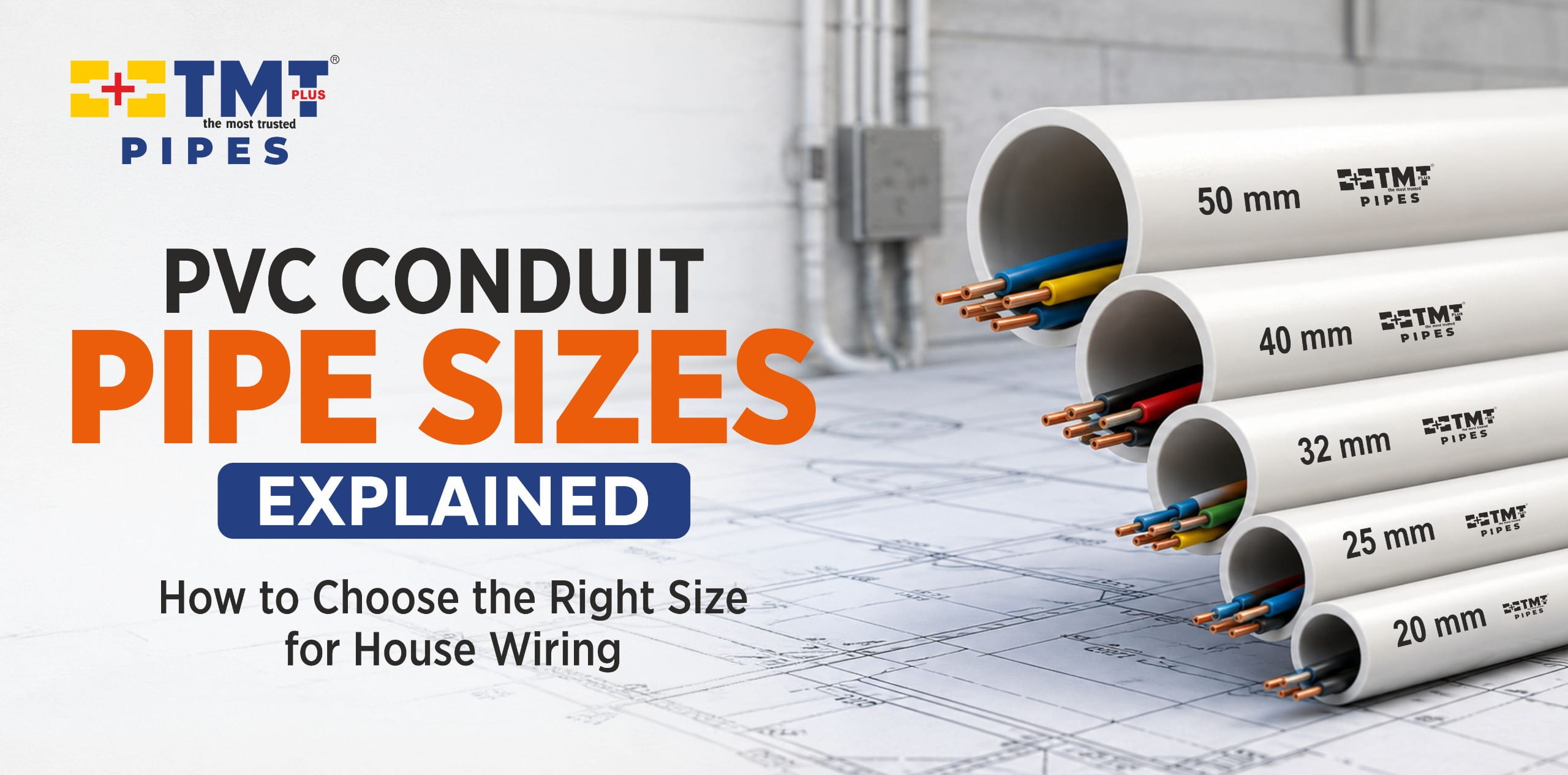
Conduit pipes in India are generally supplied in five standard nominal sizes, each suited to a different scale of wiring work.
| Conduit Size | Typical Application |
|---|---|
| 20 mm | Lighting circuits, switch boards |
| 25 mm | General room wiring |
| 32 mm | Heavy-load circuits (AC, kitchen, multiple cables) |
| 40 mm | Main distribution runs |
| 50 mm | Commercial and industrial installations |
These sizes are commonly used in residential electrical installations across India. However, the final conduit size should be determined by the electrical layout, cable specifications, and installation conditions rather than relying only on room type.
TMT Plus PVC Conduit Pipe Specifications
| Nominal Size (mm) | Outer Diameter (mm) | Tolerance on O.D. (mm) | LMS (mm) | MMS (mm) | HMS (mm) |
|---|---|---|---|---|---|
| 20 | 20 | -0.30 | 17.40 | 16.90 | 15.80 |
| 25 | 25 | -0.40 | 22.10 | 21.40 | 20.60 |
| 32 | 32 | -0.40 | 28.60 | 27.80 | 26.60 |
| 40 | 40 | -0.40 | 35.80 | 35.40 | 34.40 |
| 50 | 50 | -0.50 | 45.10 | 44.30 | 43.20 |
Which PVC Conduit Size Is Best for Different Areas of a House?
Different rooms carry different electrical loads, and sizing should reflect that rather than treating the whole house as one uniform job.
- • Living Room & Bedrooms: 20mm-25mm is plenty for standard sockets and lighting circuits.
- • Kitchen: Use 25mm-32mm to cope with heavy appliance loads.
- • Bathroom & Outdoors: Use 20mm-25mm weatherproof, moisture-sealed conduit.
- • Air Conditioners & Water Heaters: High-power units need dedicated 25mm-32mm runs for thicker cables.
- • Main Distribution Board: Requires 40mm or larger to safely route all combined wiring.
A handful of practical factors decide the right size for any given run, and it rarely comes down to a single measurement.
- • Wire Count & Gauge: More or thicker wires require larger diameters to prevent crowding.
- • Run Length & Bends: Longer runs and multiple turns increase friction; upsizing makes wire pulling easier.
- • Electrical Load: High-draw circuits use heavier cables, demanding wider conduit.
- • Future Expansion: Leaving extra capacity upfront prevents costly wall tear-outs later.
Electrical requirements often change over time. Choosing a conduit with reasonable spare capacity can make it easier to add or replace cables during future renovations without disturbing concealed wiring.
PVC Conduit Sizing for House Wiring
Understanding conduit size comes down to managing conduit fill, which is the percentage of internal space occupied by your cables. Keeping this fill ratio sensible prevents severe friction damage to wire insulation during pulling, avoids heat buildup during operation, and keeps fault-tracing straightforward down the line. Leaving spare capacity is also a practical investment for any electrical layout: because conduit electrical wiring lives inside walls for decades, extra room allows future additions or cable replacements without tearing down entire runs.
| Number of Wires | Recommended Starting Point* |
|---|---|
| 2–3 | 20 mm |
| 4–6 | 25 mm |
| 6–10 | 32 mm |
*Actual sizing should still account for wire gauge, run length, and bend count.
Conduit fill is not about fitting the maximum number of wires inside a pipe. The objective is to provide enough space for safe cable installation, easier maintenance, and future modifications where required.
Heavy Duty vs Medium Duty PVC Conduit Pipes: What's the Difference?
The difference between heavy duty and medium duty conduit comes down to wall thickness rather than nominal size. A 25mm heavy duty pipe and a 25mm medium duty pipe share the same outer diameter, but the heavy duty version has considerably thicker walls, which narrows the internal bore slightly and increases impact resistance.
Selecting the correct duty grade is just as important as selecting the correct conduit size. The installation environment should determine whether medium or heavy duty conduit is appropriate.
Which One Should You Choose for Residential Wiring?
| Factor | Medium Duty (MMS) | Heavy Duty (HMS) |
|---|---|---|
| Strength | Standard wall thickness, sufficient for typical wall cavities | Thicker walls, built for mechanical stress |
| Typical use | Standard residential and commercial wiring | Concrete casting, underground burial, industrial sites |
| Cost | Lower cost per length | Higher cost, justified only where conditions demand it |
| Recommended locations | Concealed wall and ceiling runs in homes | Driveways, underground cabling, factory floors |
For most homes, medium duty conduit covers the job without paying for strength that will never actually be tested. Heavy duty makes sense only where the pipe faces genuine mechanical stress, such as a run cast into concrete or buried outdoors.
Common Mistakes When Selecting PVC Conduit Size
- • Choosing a smaller pipe to save cost: a marginally cheaper conduit today often means a difficult, expensive rewiring job later.
- • Ignoring future wiring needs: sizing only for current requirements leaves no room for a home office addition or extra appliance circuit down the line.
- • Using low-quality conduit pipes: uncertified pipe with inconsistent wall thickness undermines even a correctly chosen nominal size.
Expert Installation Tips
- • Plan conduit routes before plastering: retrofitting a conduit route after walls are finished is far more disruptive than planning it alongside the building layout.
- • Keep bend count to a minimum: fewer bends means easier wire pulling now and simpler troubleshooting later.
- • Install junction boxes at appropriate locations: these give access points for future cable work without needing to break into a wall.
- • Label main conduit lines for future maintenance: a labelled distribution point saves considerable guesswork for whoever services the wiring years down the line.
Myths vs Facts About PVC Conduit Pipe Sizes
- • Myth: bigger pipes are always better. Oversized conduit adds unnecessary cost and does nothing for a circuit that never approaches its fill capacity.
- • Myth: one conduit size works everywhere. Load, cable count, and routing vary by room and circuit, which is exactly why standard sizing charts list a range rather than a single figure.
- • Myth: more wires can always be added later. Space depends entirely on how much fill capacity was left during the original installation, so this only holds true if the conduit was sized with some margin from the start.
How to Identify Quality PVC Conduit Pipes
- • Check for ISI certification: certified pipe has been tested against IS 9537 requirements for wall thickness, impact strength, and flame retardancy.
- • Pipe wall thickness: consistent thickness across a batch indicates proper manufacturing control.
- • Compression strength: a pipe should resist deformation under reasonable pressure, particularly for HMS grade intended for casting or burial.
- • Surface finish: a smooth, even surface, inside and out, generally reflects better manufacturing quality and eases wire pulling.
- • Manufacturer information: reputable suppliers mark their pipe clearly with size, grade, and standard compliance, which makes site verification straightforward.
Conduit Pipe Certifications
Standards give a common reference point for wall thickness, tolerance, and safety performance, which means a conduit pipe bought from one supplier behaves predictably alongside fittings from another, provided both meet the same specification. Some standards include:
- • IS 9537 Series: This is the primary Indian standard governing rigid and pliable PVC conduit pipe for electrical installations, covering dimensions, mechanical strength, and flame-retardant performance.
- • National Electrical Code of India (BIS SP 30): This code sets out broader guidance for electrical installation practice in India, including wiring layout principles that inform how conduit should be routed and sized within a building.
Real-World Example: Planning Conduit Sizes for a New Home
A newly constructed house typically includes separate circuits for lighting, socket outlets, kitchen appliances, air conditioners, and the main distribution board. Since each circuit has different cable requirements, electricians often use more than one conduit size throughout the property. This approach improves cable management, simplifies future maintenance, and provides greater flexibility if additional wiring is required later.
Conclusion
Sizing a conduit pipe correctly is less about following a single rule and more about matching pipe diameter, wall thickness, and duty grade to the actual circuit it will carry. For most homes, 20mm and 25mm medium duty conduit covers lighting and general room wiring comfortably, while 32mm and above suits heavier appliance circuits and main distribution runs. Reserving heavy duty grades for concrete casting, underground burial, or genuinely demanding conditions keeps costs sensible without compromising on safety.
Before finalising a wiring plan, it is worth reviewing the specific cable count, circuit layout, and any structural factors unique to the property with a qualified electrician. A short planning conversation before the walls go up tends to prevent a far more disruptive correction after they do.
Before purchasing PVC conduit pipes, verify the conduit size, duty grade, routing plan, and future wiring requirements. A few minutes of planning can help avoid unnecessary changes after construction is complete.
FAQs
1. Which PVC conduit size is best for house wiring?
For most homes, 20mm and 25mm conduit in the medium duty grade covers lighting and general room wiring comfortably, while heavier circuits such as air conditioners typically need 32mm.
2. Is 20mm PVC conduit enough for a home?
Yes, for lighting circuits and low-cable-count runs, 20mm conduit is generally sufficient. Rooms with multiple sockets or higher loads usually need to step up to 25mm or more.
3. When should I use a 25mm conduit?
25mm conduit suits general room wiring with several socket points or slightly higher cable counts, offering more breathing room than 20mm without the added cost of larger sizes.
4. What conduit size is suitable for AC wiring?
Air conditioner circuits typically draw higher current and use thicker gauge cable, so 32mm conduit is generally recommended to accommodate the load safely and comfortably.
5. Can I pull additional wires later?
This depends on how much spare fill capacity the original conduit was given. Sizing with a small margin during installation makes future additions considerably easier without opening the wall.
References
This guide is based on generally accepted electrical installation practices and technical references, including the BIS IS 9537 Series, National Electrical Code of India (BIS SP 30), and applicable electrical safety guidelines. Project-specific electrical designs and local regulations should always take precedence.