
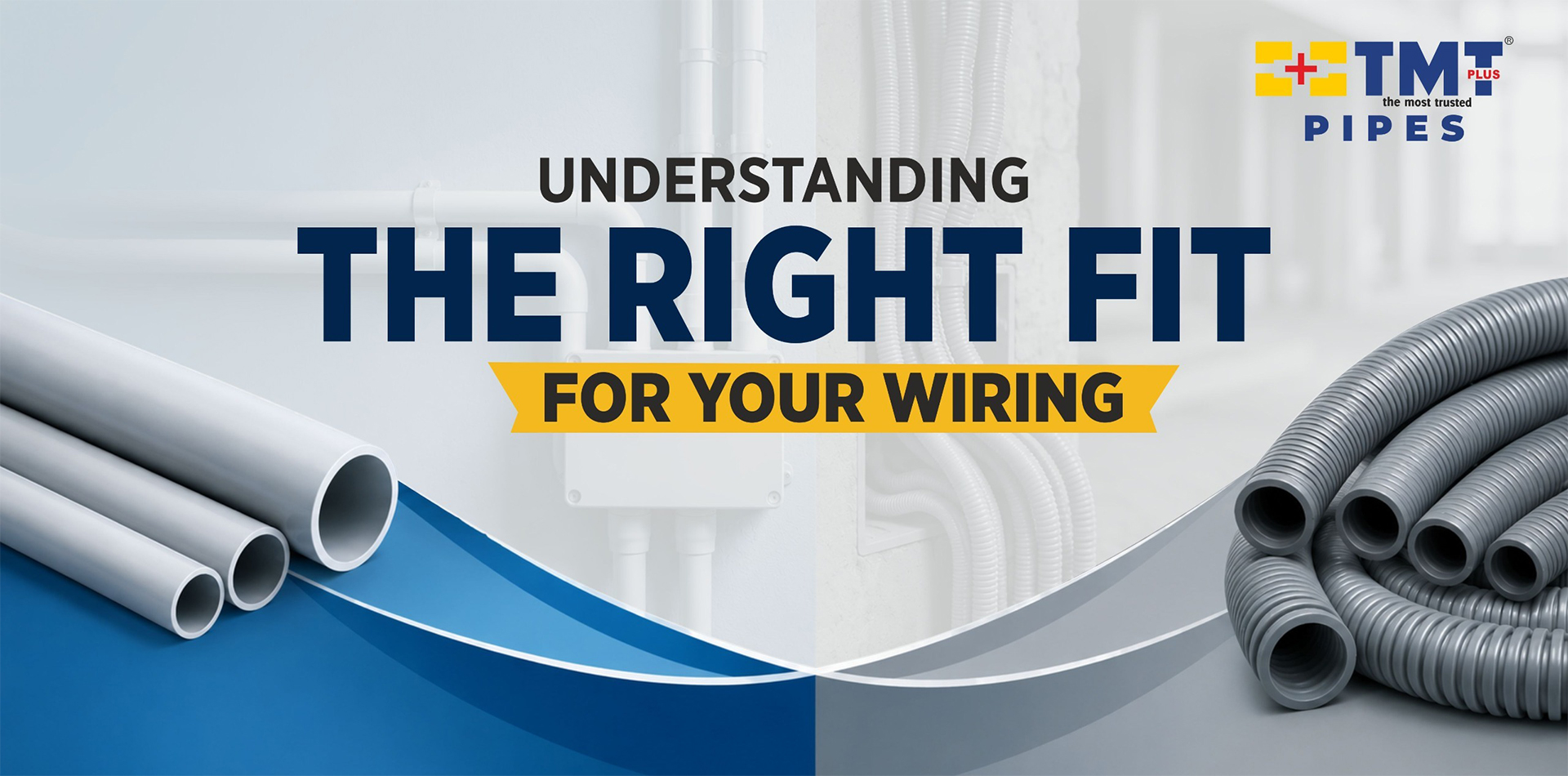
Worried about wiring damage, moisture entry, exposed wires, or electrical faults after installation? These problems may not show up immediately, but they can affect safety, repairs, and the overall reliability of your home, office, shop, or building. That is why choosing the right conduit pipe matters before the wiring work begins.
It protects electrical wires from dust, pressure, impact, bending stress, and moisture-related damage. But every space does not need the same kind of protection. Some wiring routes need a strong and fixed structure, while others need flexibility around corners, panels, false ceilings, or compact areas. Understanding the difference between rigid and flexible conduit pipes can help you make a safer and more practical choice.
In many electrical projects, both rigid and flexible conduits are used together rather than choosing just one type. The right decision usually depends on the installation area, wiring route, and future maintenance requirements rather than simply selecting the stronger option.
What Are Rigid Conduits?
Rigid conduits are firm protective pipes used to create fixed wiring routes. They are usually installed in walls, ceilings, floors, basements, parking areas, service zones, and other spaces where the wiring path is clear and stable.
They work well when the route is straight and unlikely to change often. Since they hold their shape, they give wires a stable path and help create a clean installation for homes, offices, shops, and commercial buildings.
Because rigid conduits maintain their shape, they are generally preferred when the electrical layout has already been planned. Making changes after installation is possible, but it usually requires more effort than flexible conduit systems.
Rigid conduits are usually preferred for:
- • Straight wiring routes
- • Concealed wiring inside walls
- • Exposed wiring in utility areas
- • Basements and parking spaces
- • Permanent electrical layouts
For new construction, renovation, or repair work, TMT Plus rigid conduit solutions can support safer and more organised wiring protection across different spaces.
What Are Flexible Conduits?
Flexible conduits are bendable protective systems used where wiring cannot follow a straight route. They are helpful around corners, control panels, machinery, false ceilings, and compact areas where fixed pipes may be difficult to install.
Their main advantage is adaptability. They can move through difficult routes with fewer fittings and less adjustment, especially where the site has bends, obstacles, vibration, or equipment connections.
This flexibility is especially useful during renovation work or when wiring needs to pass through existing structures without extensive modifications. It can help simplify installation in locations where rigid conduits may be difficult to route.
Flexible conduits are commonly used for:
- • False ceiling wiring
- • Lighting connections
- • Compact corners
- • Control panels
- • Machinery connections
Both conduit types serve different purposes. Comparing them side by side makes it easier to understand which option is better suited for different installation conditions.
Rigid vs Flexible Conduits: Basic Comparison
| Factor | Rigid conduits | Flexible conduits |
|---|---|---|
| Structure | Firm and fixed | Bendable and adjustable |
| Best suited for | Straight wiring routes | Curved or tight routes |
| Installation | Needs route planning | Easier in compact spaces |
| Protection | Stronger physical protection | Better for movement |
| Fittings | More fittings for bends | Fewer fittings in complex routes |
| Maintenance | Good for fixed layouts | Easier where access is needed |
| Common use | Walls, basements, exposed areas | Panels, false ceilings, equipment areas |
Both types have a clear purpose. Rigid conduits are better when the route is stable and straight. Flexible conduits are better when the route needs bending, movement, or adjustment.
Why The Right Choice Matters
Choosing between rigid and flexible conduits should not be based only on cost. It should depend on the wiring route, exposure level, safety needs, and whether future repairs may be required.
For example, concealed wiring inside a wall may need a rigid system. Wiring around a false ceiling, panel, or machine connection may need a flexible system. A home or commercial space may need both in different areas.
In many commercial buildings, contractors use both conduit types within the same project. Selecting the right conduit for each section helps improve installation efficiency while maintaining proper wire protection.
Before choosing, consider:
- • Where the wiring will be installed
- • Whether the route is straight or curved
- • How much protection the wires need
- • Whether moisture or impact may be an issue
- • Whether future access is needed
TMT Plus focuses on practical electrical piping solutions that help match wiring protection to real site conditions.
Benefits Of Rigid Conduits
Rigid conduits are valued for strength and stability. They create a fixed path for wires and reduce the chances of wiring getting crushed, pulled, bent incorrectly, or left exposed.
Key benefits include:
- • Strong protection against impact
- • Better support for long straight routes
- • Clean concealed or surface installation
- • Lower chances of wire movement
- • Useful for homes, offices, shops, and commercial buildings
A properly planned rigid conduit system also makes wiring routes look more organised, which can simplify inspection and future maintenance work.
Rigid systems are also useful where wiring remains visible. In basements, parking areas, utility rooms, and service spaces, they help keep the electrical layout neat and organised.
Benefits Of Flexible Conduits
Flexible conduits are useful when the wiring route is not simple. They can bend around obstacles, pass through tight sections, and connect different points without forcing a straight path.
Key benefits include:
- • Easier installation in compact spaces
- • Better handling around corners
- • Useful near panels and equipment
- • Suitable for areas with vibration
- • Helpful where future access may be needed
Flexible conduits are also useful where equipment may need servicing later, as accessing wiring can become easier without disturbing the surrounding installation.
For difficult wiring routes, TMT Plus flexible piping solutions can help keep the installation safer, cleaner, and better suited to the space.
Where Rigid Conduits Work Better
Rigid conduits work better in areas where the wiring route is fixed, straight, and planned in advance. These areas may include walls, ceilings, basements, utility spaces, parking areas, and exposed wiring zones.
Use rigid conduits when you need:
- • Long straight wiring routes
- • Higher impact protection
- • Clean exposed wiring lines
- • Fixed electrical layouts
- • Strong protection in exposed areas
If the layout is permanent and does not need frequent changes, rigid systems are usually the better choice.
Where Flexible Conduits Work Better
Flexible conduits work better where wiring needs to bend, move, or pass through a difficult route. They are often used near machinery, control panels, false ceilings, lighting points, and compact corners.
Use flexible conduits when you need:
- • Wiring around corners
- • Connections near panels
- • Wiring through false ceilings
- • Support near equipment
- • Routes with vibration or movement
They reduce installation difficulty when a straight path is not possible. Instead of using too many joints, flexible systems allow wires to pass through more naturally.
Instead of choosing one conduit type for the entire building, experienced installers often evaluate each installation area separately to achieve the best balance between protection and ease of installation.
Site-Based Comparison
| Site condition | Better option | Why it works better |
|---|---|---|
| Straight wall wiring | Rigid conduits | Gives a fixed and protected route |
| False ceiling wiring | Flexible conduits | Easier in compact spaces |
| Basement or parking area | Rigid conduits | Stronger protection in exposed zones |
| Machinery connection | Flexible conduits | Handles movement and vibration better |
| Long commercial runs | Rigid conduits | Supports organised wiring across distance |
| Control panel wiring | Flexible conduits | Allows easier connection and access |
| Permanent concealed wiring | Rigid conduits | Better for fixed layouts |
Instead of asking which one is better overall, ask which one is better for each part of your property.
Other Factors To Consider
Rigid conduits usually offer better physical protection because of their firm structure. Flexible conduits handle movement better and reduce stress where vibration or shifting may happen.
Before installation, also check:
- • Route length and number of bends
- • Wall, ceiling, or panel access
- • Exposure to moisture or impact
- • Future repair or maintenance needs
- • Product quality and fittings
The main purpose of an electrical conduit pipe is to protect wires and reduce electrical risk. Good selection can help reduce exposed wiring, moisture-related damage, wire abrasions, loose routing, and repair difficulties.
Selecting the right conduit at the planning stage can also reduce unnecessary repairs and help maintain a cleaner electrical installation throughout the life of the building.
Choosing The Right Conduit Solution From TMT Plus
Once you understand the difference between rigid and flexible conduits, the next step is choosing the right solution for your actual space. The wiring route, exposure level, bending requirement, and maintenance access should guide the decision.
At TMT Plus, we understand that every electrical project has different installation requirements. Rather than recommending one solution for every application, our focus is on offering conduit systems that suit different environments while supporting safer and more organised wiring installations.
It should also include:
- • Product durability
- • Ease of installation
- • Application fit
- • Wiring safety
- • Long-term performance
A good choice can help reduce wiring damage, avoid messy installation, and make future maintenance easier.
Cost Considerations
Cost depends on material, installation time, fittings, labour, site complexity, and project size. Rigid conduits may need more fittings for bends and turns, while flexible conduits may reduce labour in complex routes.
Looking only at the purchase price can sometimes be misleading. Installation effort, the number of fittings required, ease of maintenance, and long-term durability all contribute to the overall project cost.
When comparing cost, look at:
- • Product quality
- • Installation effort
- • Number of fittings required
- • Future repair access
- • Long-term reliability
For homes, shops, offices, and larger properties, the right mix can help balance cost, safety, installation speed, and long-term performance.
So, Which One Is Better?
There is no single winner. Rigid conduits are better for strength, structure, and straight wiring routes. Flexible conduits are better for bends, movement, tight spaces, and equipment connections.
Choose rigid when you need:
- • A fixed route
- • Stronger protection
- • A neat exposed layout
- • Long straight wiring runs
Choose flexible when you need:
- • Bending around corners
- • Easier installation in tight spaces
- • Movement support
- • Access near panels or equipment
In most cases, the best decision is not choosing one over the other. It is using each one where it works best.
Final Thoughts
Rigid and flexible conduits both protect electrical wiring, but they solve different problems. Rigid systems offer structure, strength, and a clean fixed route. Flexible systems offer easier movement, better bending, and practical support in difficult spaces. A smart electrical layout may use both depending on the area and application.
Before finalising, look at the wiring route, safety needs, exposure level, bending requirement, and maintenance access. It also helps to speak with an electrician or a trusted conduit pipe supplier before purchase. The right recommendation can save time, reduce waste, and improve safety.
Common Mistakes to Avoid While Choosing Conduit Pipes
- • Choosing a conduit based only on price.
- • Using the same conduit type throughout the project without considering different installation areas.
- • Ignoring future maintenance requirements.
- • Selecting poor-quality fittings with good conduit pipes.
- • Not consulting a qualified electrician before installation.
FAQs
1: Does TMT Plus offer conduit solutions for both homes and commercial spaces?
Yes, TMT Plus conduit solutions can be considered for homes, offices, shops, commercial buildings, and industrial spaces. The right choice depends on the wiring route, protection needs, site conditions, and installation plan.
2: How do I choose between rigid and flexible conduit pipes?
Choose rigid conduits for straight, fixed wiring routes and stronger protection. Choose flexible conduits for corners, panels, false ceilings, compact spaces, or areas with movement. A qualified electrician can help select the right option.
3: Why is conduit quality important for electrical wiring?
Good conduit quality helps protect wires from dust, moisture, pressure, impact, and bending stress. It also supports cleaner installation, better wire safety, and easier long-term maintenance across residential and commercial electrical work.
4: Can TMT Plus conduit pipes be used during renovation work?
Yes, they can be considered during renovation, repair, or new electrical installation work. The final selection should depend on the wiring layout, space restrictions, wall access, false ceiling design, and safety requirements.
5: What should I check before buying conduit pipes?
Check the application area, pipe strength, flexibility needs, installation route, moisture exposure, fittings, and long-term maintenance access. It is also better to consult an electrician before finalising the product for your property.